Meet Our Experts: Imane Gamal
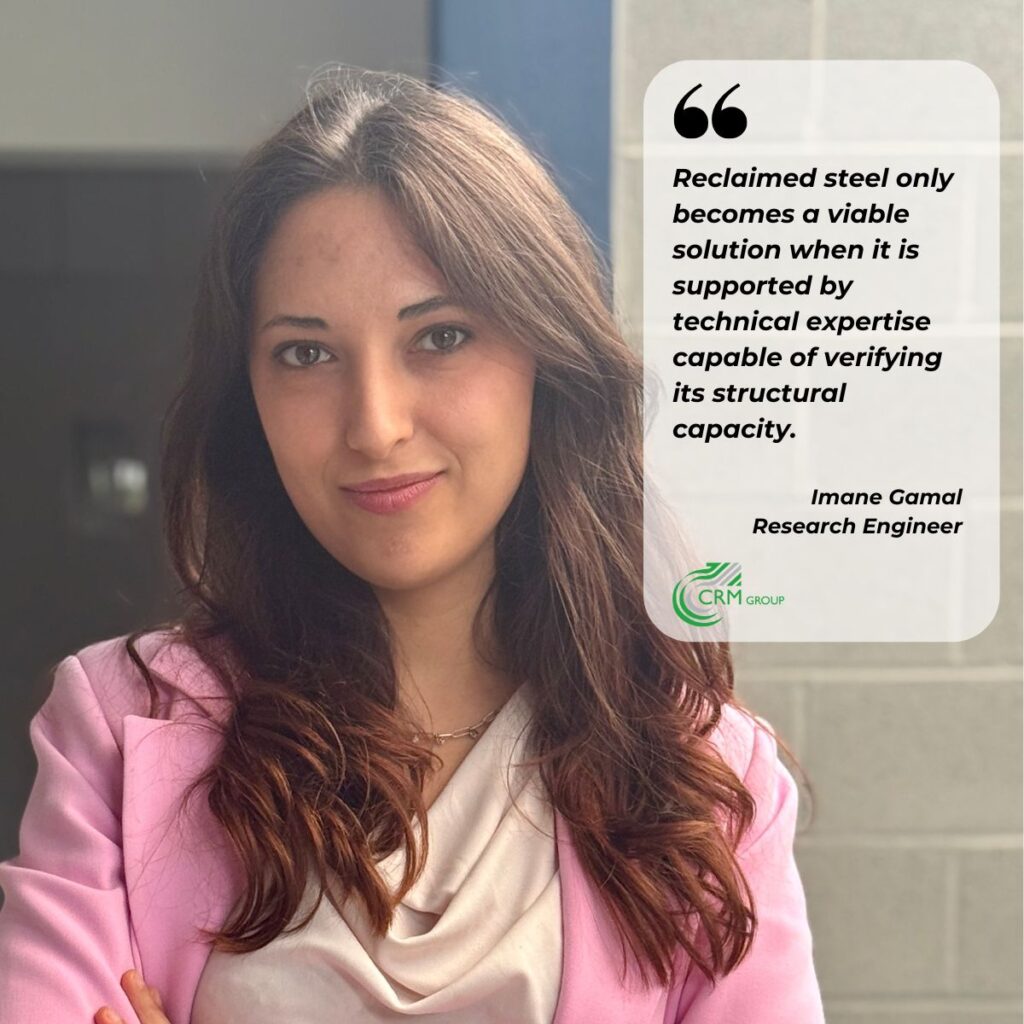
At CRM Group, innovation is driven by people. Behind every breakthrough lies the expertise and passion of our teams. In this interview, we meet Imane, one of our dedicated experts, who shares her insights into our Civil Engineering Unit and gives us a closer look at the challenges, ambitions, and technologies shaping her work.
First, can you introduce yourself, tell us how long you’ve been working at CRM Group, your career and explain your current role?
I graduated in 2025 as an Industrial Engineer, specializing in electromechanics and aeronautics. I started at CRM Group through my final-year project, which focused on the recycling of galvanized steels.
I then joined the Construction Unit at CRM Group, where I have been working for the past nine months as a Research Engineer.
As part of my role, I am currently leading the development and market deployment of an innovative service dedicated to the requalification of reclaimed structural steels. This activity aims to structure a new value chain by providing reliable and standardized solutions that secure and facilitate the integration of reclaimed metallic materials into construction projects.
Beyond the technical aspects, my role also includes a strong strategic dimension: identifying opportunities, structuring a new activity around steel reuse, and contributing to the development of sustainable and scalable solutions.
This approach allows me to combine engineering expertise with strategic vision, supporting the transformation of industry expectations and the transition towards a circular economy.
You mentioned the requalification of construction elements for reuse. Can you tell us more?
Reuse consists of taking structural elements that have already been used in a building, recovering them during deconstruction, and integrating them into new projects.
However, the properties of these elements are often no longer known and may have deteriorated during their first life. As a result, their direct reuse is not compliant with current standards and can raise concerns in terms of safety and insurability.
Reusing structural elements without knowing their strength is unsound and endangers the safety of dozens or even hundreds of people.
It is therefore essential to reassess their performance.
Our requalification process complies with the Standard for the reuse of metallic components (CEN/TS 1090-201:2024) and consists of carrying out mechanical and chemical tests in accordance with ISO 17025. The objective is to determine their level of equivalence in order to facilitate their integration into construction projects (new builds or renovations) from the earliest stages of design.
How did you become involved in steel reuse?
CRM Group has strong expertise in testing and characterization of metallic materials. It was therefore a natural fit for us to become involved when the need to requalify steel for reuse arose around 2023.
Since then, a structured and standardized testing protocol has been developed to reliably and rigorously govern these practices. In this context, we have built a dedicated offering, designed to respond quickly to market needs, while acquiring specific expertise in steel reuse.
Today, we are among the key players in the local market for steel requalification for reuse.
Why is there a growing need to work on reuse?
More and more projects, particularly those funded by public authorities, are subject to stricter carbon footprint requirements and include quantified targets for material reuse.
In this context, project owners must demonstrate a reduction in their environmental impact, while designers must incorporate a certain percentage of reused materials. This results in a growing need for reliable solutions that ensure both compliance and performance.
Beyond regulatory requirements, we also observe a shift in practices. Some project owners and designers voluntarily engage in reuse initiatives, driven by environmental conviction, but also by the desire to anticipate sector transformations, develop new skills, remain competitive, and stand out through innovative projects.
Lastly, what advice would you give to a young student entering this field today?
The needs are evolving rapidly, and innovation often lies in turning constraints into opportunities. During your studies, try to connect theory with real-world applications: take an interest in industry, ask questions, and use internships and projects to explore different fields.
Stay curious and open-minded. The role of a research engineer is far more diverse than it may seem, requiring both technical rigor and the ability to adapt, understand real-world challenges, and develop practical solutions.
Finally, don’t see your degree as an end goal. Learn how to learn, develop your autonomy, and try as many things as possible. This is what will help you find your path and thrive in a constantly evolving field.
I also believe it is essential to work in an environment where people’s skills, motivations, and personalities are valued. This is what enables long-term engagement and professional fulfillment. Passion for your work is not something that simply happens. It is built in an environment that empowers individuals to contribute fully.