
SteelReuse
Introduction
“The EU’s transition to a circular economy is crucial for reducing pressure on natural resources, halting biodiversity loss, achieving climate neutrality by 2050, and building a more resilient and competitive Europe.” European Commission, 2020
Since 2023, a recurring question has been emerging across the construction sector: “I have steel elements recovered from a deconstruction site – can I reuse them? How do I ensure they are safe and reliable?”
The answer lies in requalification: a structured process of mechanical and chemical testing designed to reassess the properties and load-bearing capacity of reclaimed steel elements, enabling their safe and compliant integration into new construction projects.
Context
The challenge of reclaimed steel
Steel elements recovered from dismantled structures often come with a critical lack of traceability. Their mechanical and chemical properties – and therefore their steel grade – are typically unknown. Their performance may have been altered during their first service life, and their structural integrity cannot be assumed.
This uncertainty creates real barriers across the construction ecosystem. Engineers cannot incorporate these materials into structural calculations without reliable data. Companies face both technical and legal risks. And insurers require solid guarantees before coverage can be granted.
The SteelReuse project addresses these barriers directly, unlocking the potential for safe and compliant steel reuse.
Objectives
What SteelReuse enables
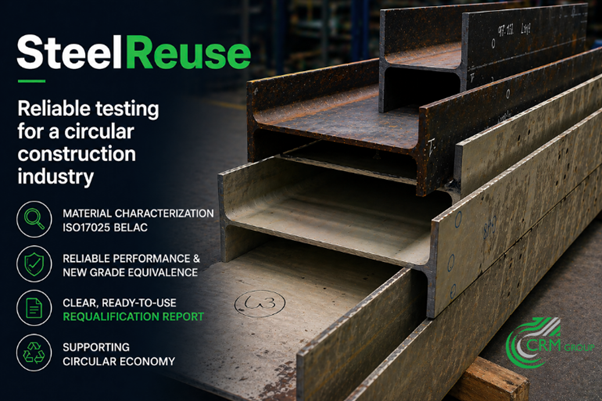
- Assess the mechanical and chemical properties of steel elements recovered from deconstruction
- Determine an equivalent grade to new steel compliant with EN 10025-2, enabling direct integration into construction calculations
- Ensure full compliance with the European Technical Specification for the reuse of metallic components CEN/TS 1090-201:2024
- Facilitate the work of structural engineers, project owners, contractors and developers by providing reliable, standardized documentation
- Contribute to reducing the environmental footprint of metal structures through material circularity
Project Overview
CRM Group’s expertise at the service of reuse
A recognized metallurgical partner
With over 75 years of expertise in metallurgical innovation, CRM Group is a trusted partner for the metals and construction industries. Circular economy has become one of our core specializations, and we are actively committed to supporting the construction sector’s transition toward more sustainable practices.
Certified testing, reliable results
All requalification tests carried out under the SteelReuse framework are performed in accordance with ISO 17025, under BELAC accreditation. This guarantees the quality, traceability and reliability of our results.
A service designed for the market
Our requalification service is built around the real needs of construction stakeholders. Whether you are working on a new build, a renovation, or a public project with circular economy requirements, we offer a fast, rigorous and standardized response that turns reclaimed steel into a fully documented and usable resource.
Conclusion
As regulatory pressure increases and voluntary commitments to circularity grow across the construction sector, the ability to reliably reuse structural steel is becoming a competitive advantage – not just an environmental ambition.
Interested in requalifying your reclaimed steel elements?
Partners
An initiative of CRM Group